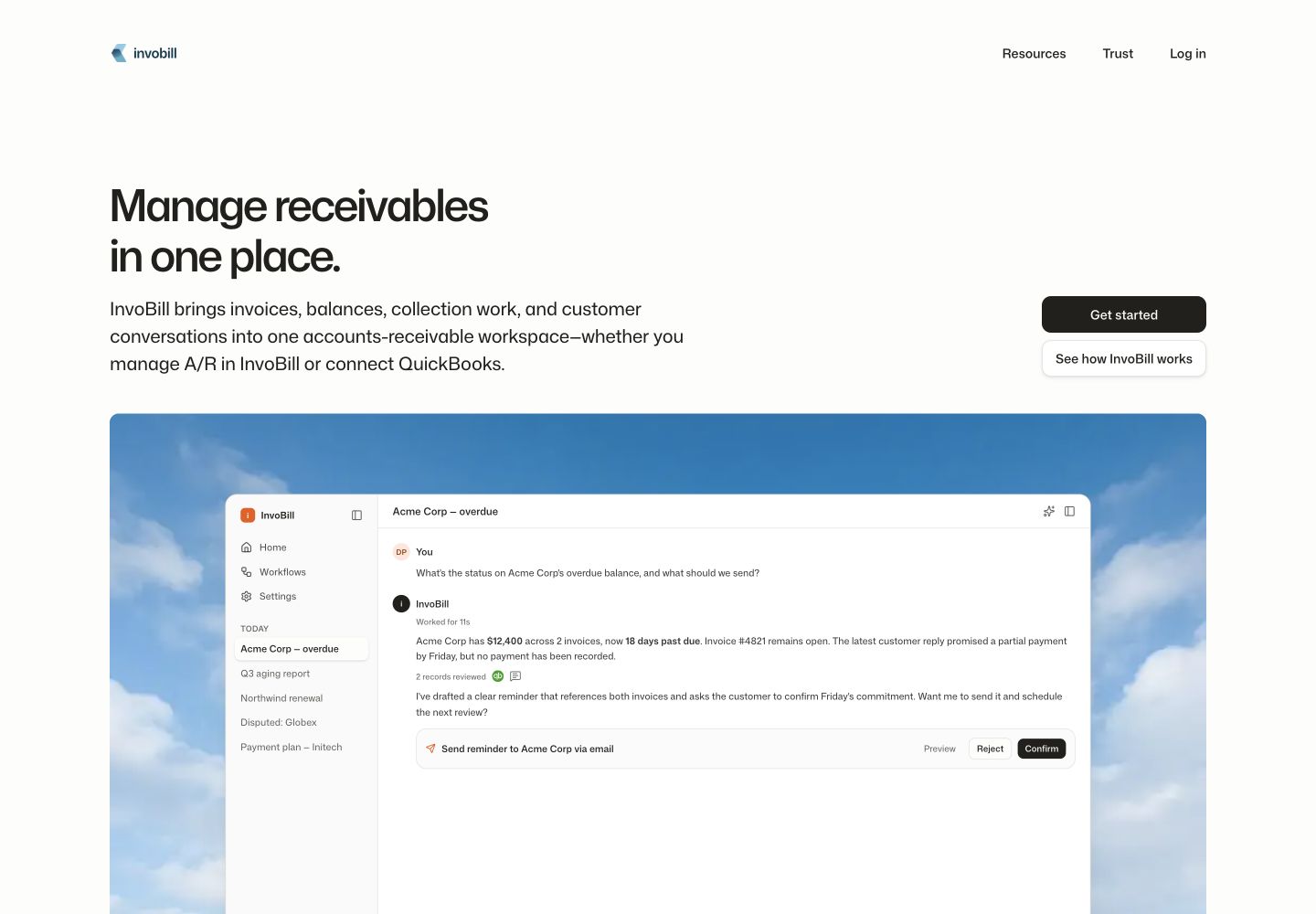
InvoBill
Product direction, design and implementationCustomer-level collection work, tied to the right invoices.
- Role
- Product owner
- Period
- February–September 2026
The starting point
I joined an existing receivables MVP as product owner. Customer context, invoices, collection work, messages, reminders and next actions were spread across separate interfaces. Making the screens look better was only part of the problem: the work itself needed a clearer shape.
My role
Through late July, I worked on product direction with two engineers. After they left, I took on substantial hands-on implementation with Codex. The product included inherited and team-built work; this case focuses on the decisions and changes I contributed to.
The job to make clearer
A collector needs to understand the customer, know which invoices an action concerns, communicate clearly, record what happened and leave a useful next step.
Workflow model · explanatory, not an app screenshot
- Customer context
- Invoice scope
- Action
- Outcome
- Follow-up
Three decisions that shaped the work
Start with the customer
I made customer-level collection work the organizing unit, while keeping each action tied to its exact invoice scope. A customer relationship can span several invoices. An invoice-only view would fragment that relationship; a customer-only view could make financial scope ambiguous. The flow needed both levels of context.
Keep conversations flexible
Customer conversations could carry invoice context when it was useful, rather than forcing every exchange into one invoice-specific thread. Tasks, due dates and follow-ups belonged to the same collection lifecycle, so the next action could stay connected to the conversation.
Separate a response from a financial fact
A promise to pay, a dispute or a customer saying they paid is a human outcome. It is not an accounting-confirmed settlement. The same boundary matters for connected accounting data: a sync job completing does not, by itself, establish that the financial facts are correct.
From direction to implementation
My later implementation work included conversations, tasks, calendar, receivables import paths and connected accounting workflows, alongside interface rebuilding and release checks. I also worked on product positioning and the public website/demo handoff. The public website is linked for context; it is not proof that I authored every part of its implementation.
What the evidence supports
The supporting evidence includes controlled communications and demo-intake checks. Those checks establish that specific paths were tested, rather than sustained customer adoption. Collection improvements, saved staff time and revenue impact were not demonstrated. The reliability work also did not establish continuous, autonomous accounting correctness in production.
What I took from it
For a small team, this meant keeping product decisions and implementation connected: the same workflow model carried through conversations, tasks and accounting boundaries. The useful unit of product work was the whole operational flow: context, scope, action, evidence and what happens next. That is the kind of bounded workflow I like to shape and build.